Reading Anthropic's IPO Setup: Mythos, Government Relations, and the Pieces Falling Into Place
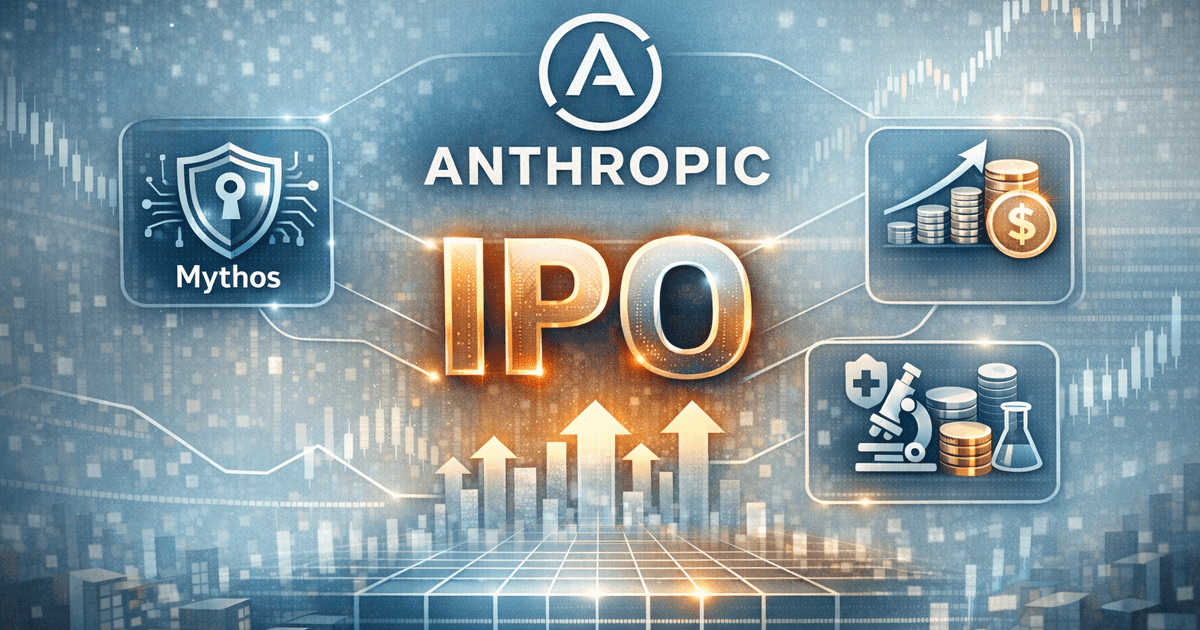
In April 2026, a number of moves at Anthropic felt like they were pointing toward an IPO. A new model called Mythos. Renewed dialogue with the US government. The launch of Claude Design for enterprise work. And continued revenue growth.
Mythos, in particular, stands out. It is not just a performance upgrade. From my point of view, it looks like a card Anthropic can use to rebuild its relationship with the US government.
Line these headlines up side by side and they read less like separate news items, and more like pieces falling into place for an IPO. In this post I first organize the facts, and then think through what the strategic picture looks like.
The Facts: Eight Moves in April
1. Rebuilding the US Government Relationship
There had been clear tension between Anthropic and the US government. According to Reuters, on April 17 CEO Dario Amodei met with senior White House officials to discuss cooperation on AI safety and cybersecurity. The report described this meeting as a sign that both sides are starting to rebuild trust after a dispute with the Pentagon. Per the same report, the background includes a dispute over how Anthropic’s models were being used, especially concerns tied to autonomous weapons.
2. The Arrival of Mythos
On April 7, Anthropic’s safety team announced that Claude Mythos Preview shows “notably high capability” on computer security tasks.
Alongside this, Anthropic launched Project Glasswing to strengthen the defense of critical software, and said Mythos Preview is being used under limited access for defensive cybersecurity. The public writeup focuses on the model’s ability to find and analyze previously undisclosed vulnerabilities — zero-days — and Anthropic itself calls this a “watershed moment in security.”
I covered the technical impact of Mythos in more detail here: Anthropic’s Claude Mythos: A Paradigm Shift Toward AI-Native Security
3. The US Government Is Preparing to Make Mythos Available to Federal Agencies
On April 16, Reuters reported that the US government is preparing to make a version of Mythos available for use at key federal agencies. Mythos is being offered to a limited number of organizations as part of Project Glasswing, for defensive cybersecurity purposes. The White House Office of Management and Budget is reported to be setting up guardrails for the rollout.
What matters here is the shift in how the government sees this model. Mythos is no longer framed only as “dangerous, so restrict it” — it is now also being treated as “dangerous, so we want it on the defensive side.”
4. Revenue Is Growing Fast, but the Headline Numbers Need Care
On the financial side, growth is very fast. Reuters reported on April 8 that Anthropic’s annualized revenue has passed $30 billion. The article notes that despite a big gap to OpenAI at the start of the year, Anthropic has closed it quickly with enterprise AI tools like Claude Code.
That said, Reuters Breakingviews points out that Anthropic’s “run-rate revenue” is not the same as GAAP revenue. It annualizes usage-based revenue, so reading the headline number as realized revenue would be a mistake.
5. Revenue Is Mainly Usage-Based From Large Enterprise Customers
According to the same Reuters Breakingviews piece, court documents from CFO Krishna Rao show that cumulative GAAP revenue from 2023 through the end of 2025 was over $5 billion, and that about 80% of revenue comes from large enterprise customers, most of it priced on consumption.
So the growth itself is real and strong, but the numbers being discussed mix “historical GAAP revenue” with “current usage pace annualized.”
6. Claude Design Pushes Further Into B2B
On April 17, Anthropic announced Claude Design, which lets users produce design work, prototypes, slides, and one-pagers inside Claude. Per the official announcement, it is in research preview but is available for Pro, Max, Team, and Enterprise, with design-system propagation and PPTX export included.
That reads as Claude stepping directly into fairly deep parts of work that SaaS products have traditionally owned.
7. Board Appointment: Preparing for Specialized Industries
On April 14, Novartis CEO Vas Narasimhan joined Anthropic’s board. The official announcement positions healthcare and life sciences as key areas for AI, and this appointment reinforces that direction. Reuters also describes it as bringing pharma-industry operating experience into Anthropic’s governance.
This suggests Anthropic is pushing further into B2B and trying to expand into specialized fields like life sciences and pharma. Those fields depend on research data, domain knowledge, and regulatory understanding. That is exactly why bringing domain leaders into management and governance carries real weight.
8. Google and Broadcom Partnership Expansion: Securing Compute
On April 6, Anthropic announced an expanded partnership with Google and Broadcom. According to the announcement, the company signed new agreements for multi-gigawatt scale next-generation TPU capacity, to be brought online from 2027 onward. CFO Krishna Rao described this as the company’s largest compute commitment to date, to keep up with surging customer demand.
This is a positive signal for Anthropic’s growth outlook. The flip side is that securing compute has itself become one of the most important management issues. Strong demand also brings concerns about supply constraints and margins. From an IPO-reading standpoint, this is something to watch.
Analysis: Mythos as a Card That Shifts the Government Relationship
From my point of view, the most important development here is that Mythos is functioning as a card Anthropic can play to ease tension with the US government.
Anthropic has been cautious about its AI being used for offensive purposes, especially in contexts like autonomous weapons. On the other side, the US government — particularly national security agencies — has strong demand for using advanced AI in defense and cyber work. That gap was part of what kept the two sides apart.
Mythos enters that picture not just as a high-performance model, but as a model that shows strong performance on defensive cybersecurity. For Anthropic, the line against offensive use stays in place while defensive use is easier to cooperate on. For the government, from the standpoint of protecting national networks and critical infrastructure, this is a capability they would very much want to have.
In other words, Mythos is the kind of model that can turn the AI-for-national-security question from “offensive” into “defensive,” which opens a path toward easing tensions. It gives Anthropic and the government a point where their interests can meet, and it appears to be helping move things toward a more constructive relationship.
If that trajectory continues, the political risk that could have weighed on an IPO starts to look more manageable. That is why I see Mythos not just as a new model, but as a strategic piece in the IPO setup.
Revenue Structure: A Usage-Based Core
Another important point is that Anthropic looks like it is building its revenue structure around usage-based pricing.
With enterprise demand growing quickly, taking that demand through APIs and metered add-ons is easier to explain in terms of both growth and margin. That is why products like Claude Code and Claude Design, aimed at enterprise workflows, are being used to accelerate usage-based revenue.
The Board: Preparing for Specialized Industries
The board change fits the same context. Bringing in the Novartis CEO suggests Anthropic wants to go deeper into B2B and expand into specialized industries like life sciences and pharma.
Those fields require access to research data, domain knowledge, and the working context of the industry. Entering them is not just about model quality — it depends heavily on how you secure domain-appropriate data.
On top of that, fields like healthcare and drug discovery demand an understanding of regulation and industry practice. Technical capability alone is not enough to enter these markets. Implementation responsibility, accountability, and in some cases connection to policy and rules all come with it. Given that, pulling domain leaders into management and governance carries real weight.
The board appointment, then, is a move that shows Anthropic is preparing to enter the working reality and regulatory environment of specialized industries — not just to remain a general-purpose model company. I see this as one more piece of evidence that growth can continue after an IPO.
Wrap-Up: Pieces Falling Into Place
What is visible at Anthropic now is that several important moves are happening at the same time, pointing toward an IPO.
The biggest one is that Mythos is starting to function as a card for reshaping the relationship with the government. By holding the line on offensive use and showing strong performance on defensive cybersecurity, Anthropic has found a point of contact with government demand. The political tension that would have weighed on an IPO is beginning to take a different shape.
At the same time, enterprise-focused products like Claude Code and Claude Design show Anthropic going deeper into business AI. On the revenue side, the center of gravity is shifting toward usage-based pricing rather than flat subscriptions, which is consistent with focusing on both top-line growth and margin improvement.
Beyond that, board appointments aimed at specialized fields like life sciences and pharma, as well as the compute deals with Google and Broadcom, can be read as steps to harden the business foundation for the post-IPO stage.
Government relations, revenue structure, B2B expansion, specialized-industry entry, and supply readiness — several threads are converging toward the same direction. My read is that Anthropic is now in the stage where those pieces are starting to line up.
Join the conversation on LinkedIn — share your thoughts and comments.
Discuss on LinkedInRelated Posts

Anthropic's Claude Mythos: A Paradigm Shift Toward AI-Native Security
Reading the OpenAI and Anthropic IPOs Through an Investor Lens — Risks to Watch Before the Hype